Headaches are among the most common medical complaints in clinics and hospitals worldwide. Proper coding is not just administrative, it’s essential for accurate diagnosis, treatment planning, reimbursement, and health-data analytics. In this article, we’ll walk you through the ICD 10 code for headache, most notably R51.9, how it relates to unspecified and severe headaches, variants like frontal headache or cervicogenic headache, and how to use these codes in practice. Whether you are a clinician, coder, administrator or patient wanting to understand more this blog gives you clarity, real-world context, and practical takeaways.
What is the ICD 10 Code for Headache?
The Base Code
The general code for headache is R51 – Headache. In the ICD-10-CM classification, this falls under Chapter 18: “Symptoms, signs and abnormal clinical and laboratory findings, not elsewhere classified (R00–R99)”.
The Unspecified Version
When a headache is documented but no more specific type is identified, the code used is R51.9 – Headache, unspecified. In medical billing, this code is applied when the provider records a headache complaint (head pain) but the documentation lacks defining features of migraine, tension-type, cluster, cervicogenic, or other specific headache categories.
Accurate use of R51.9 is crucial in medical coding because it ensures proper claim submission and prevents denials caused by vague or incomplete documentation. Some sources refer to it as the “diagnosis code R51.9” or the “headache ICD10 for unspecified.” For example, as defined in official coding references: “The ICD-10 code for unspecified headache is R51.9, used when no specific headache type is documented.”
Why Using the Correct ICD 10 Headache Code Matters
- Clinical clarity:
When a model of headache is identified (e.g., migraine, tension, cervicogenic), using a specific code helps guide care and referral.
- Billing and reimbursement:
Payers often assess claims based on the specificity of diagnosis codes. Overuse of unspecified codes like R51.9 may raise flags for audits.
- Data and research:
Accurate coding supports epidemiology (how common are headaches?), quality metrics, and health-services research.
- Communication:
Between providers, the code helps create a shorthand for what has not been identified — e.g., “headache unspecified” means there’s no defined subtype yet.
Key Codes for Headache – Quick Reference
| Code | Descriptor | Use Case |
| R51 | Headache (general) | When you only identify “headache” in general. |
| R51.9 | Headache, unspecified | When the headache is documented but no subtype found. |
| R51.0 | Headache with orthostatic component, not elsewhere classified | Rare: headaches triggered by positional change (orthostatic). |
| G44.86 | Cervicogenic headache (a subtype) | When the headache is attributed to cervical spine/neck origin. |
| Other G-codes | E.g., migraines (G43.–), tension-type (G44.2) etc. | When specific headache diagnosis is established. |
Deep Dive: R51.9 – Headache, Unspecified
What It Includes
- A person complains of head pain (headache) and there is no documented subtype like migraine, tension, cluster etc.
- Documentation states something like “patient presents with headache, no aura, no identified cause, neurological exam normal” and the professional chooses R51.9.
- According to coding guides: “The ICD 10 code for headache unspecified is R51.9, used when the headache type cannot be determined.”
What It Excludes
- If the headache meets criteria for migraine (G43), tension-type (G44.2), cervicogenic (G44.86), cluster (G44.0) or other defined syndrome → you should not use R51.9.
- For example, a headache clearly caused by trauma → you would code the underlying cause rather than unspecified.
Documentation Best Practices
- Clearly record the nature of the headache: duration, location, intensity, triggers, associated symptoms (nausea, photophobia, neck pain etc.).
- State negative findings (e.g., “no aura, no neck stiffness, neuro exam normal”) when you intend to use R51.9. This supports “unspecified” because you’ve ruled out more specific causes.
- Avoid using R51.9 routinely when the documentation indicates features of a specific headache type — this may trigger audit risk.
Example case
A 45-year-old patient presents with a dull frontal headache for several days, denies nausea or visual changes, has no prior headache history, exam and basic labs are unremarkable. No clear subtype identified yet. The provider documents “Headache, unspecified (R51.9)”. This is appropriate.
Later, if the patient returns and meets migraine criteria, the code should change to G43- series instead of R51.9.
Severe Headache? What About “Severe Headache ICD10”?
You may encounter the phrase “severe headache ICD10” in searches. But in ICD-10-CM, severity alone is not always the basis for a different code if the headache remains unspecified. If the provider documents “severe headache” but doesn’t identify subtype, R51.9 is still used. The term “severe” does not automatically change the code.
However, when severity corresponds with a specific type (for example, a status migrainosus under G43), then you would choose the specific code. Always match the clinical diagnosis/subtype first, then severity.
Special Cases: Frontal Headache, Head Pain, Common Headaches
-
Frontal headache ICD10
If a headache is documented as frontal (i.e., pain in the front of the head) but no further subtype is identified, you may still default to R51.9. The location alone (frontal) doesn’t make it a different code unless the clinician identifies a subtype.
-
Head pain ICD10
When someone reports “head pain” rather than a classic “headache”, it may still be coded under R51 (or R51.9 if unspecified) because the ICD code group covers “headache”, defined broadly as pain in the head region.
-
Common headaches ICD10
Many patients present with what we call “common headaches” (e.g., tension-type). If tension-type headache is clinically established, use G44.2- series, not R51.9. It’s important for coders and providers to distinguish generic headache vs specific type.
Cervicogenic Headache ICD10 – A Specific Headache Type
A subtype of headache worth discussing is G44.86 – Cervicogenic headache (i.e., headache originating from the cervical spine/neck).
What you should know
- This code applies when the headache is attributed to a disorder of the cervical spine or soft tissue structures in the neck.
- Documentation should include: evidence of cervical disorder (imaging or exam), reduced cervical range of motion or provocative neck maneuvers causing headache.
- Importantly: If cervical origin is documented, coding R51.9 would be inappropriate because a specific subtype exists.
Practical scenario
A patient has chronic right-side head pain that began after a neck injury, imaging reveals C5-C6 disc bulge, and manual exam recreates the headache when pressing neck muscles. The clinician diagnoses cervicogenic headache, code G44.86 is used (and you may also add the cervical spine disorder code as “code also”).
How to Decide When to Use R51.9 or a Specific Headache ICD-10 Code
- Identify if there is a specific headache diagnosis (migraine, cluster, tension-type, cervicogenic etc.).
- If yes → use the specific code (e.g., G43, G44.2, G44.86).
- If no subtype is documented, then use R51.9 – headache, unspecified.
- Check documentation. Does it lack features of specific types? Are associated symptoms absent? If yes → unspecified code is justified.
- Severity and location (frontal, temporal, etc.) alone don’t change the code to something more specific unless subtype criteria are met.
- Update code if clinical picture evolves. If in future a subtype becomes clear, code should change accordingly to maintain accuracy.
- Billing/insurance check is a must. Ensure the code aligns with clinical documentation to reduce risk of claim denial or audit.
Common Pitfalls & How to Avoid Them
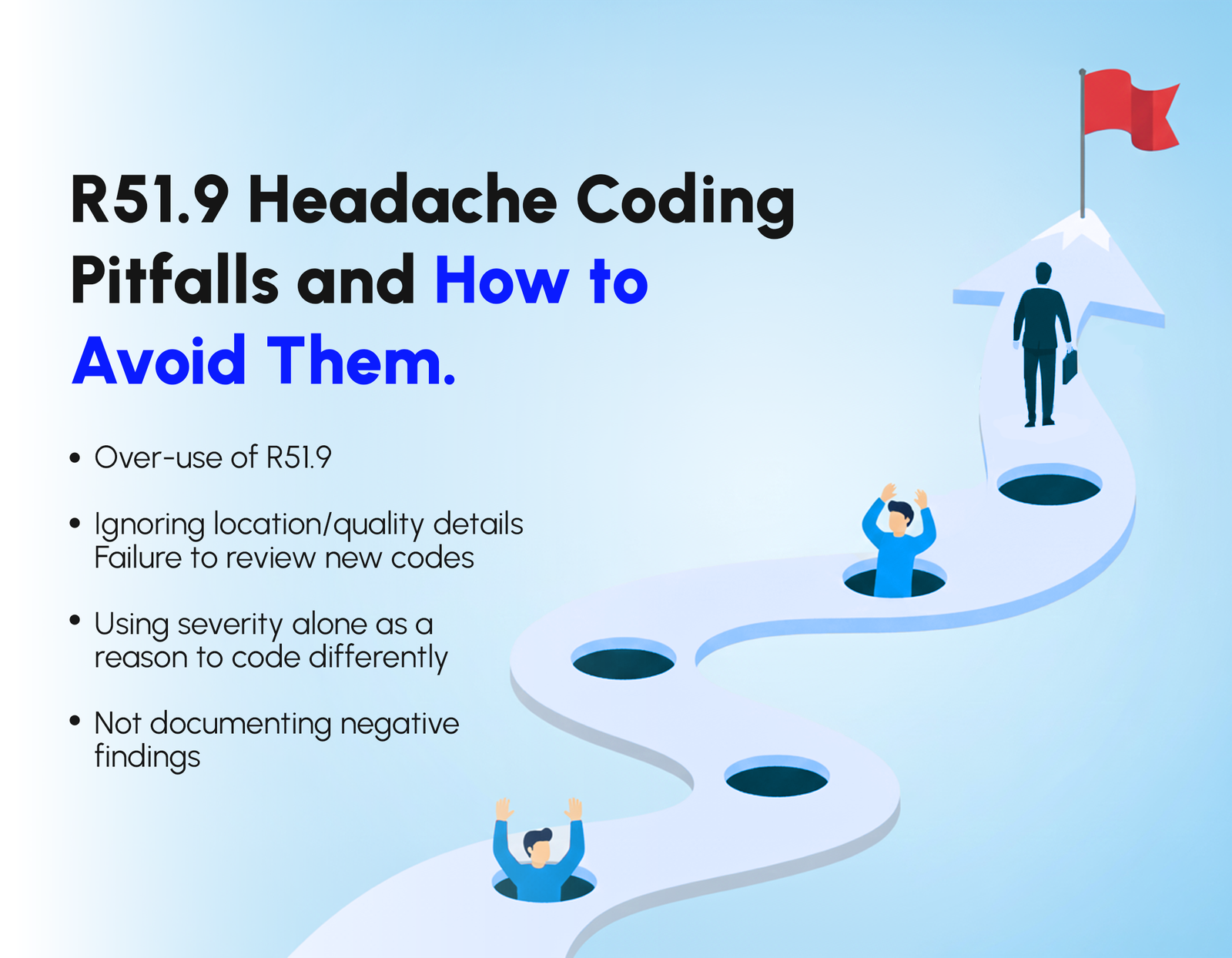
- Over-use of R51.9: Using it when the documentation actually supports a more specific subtype may lead to audit risk.
- Ignoring location/quality details: Without description of triggers, associated symptoms, or exam findings, you may miss an opportunity to code more specifically.
- Failure to review new codes: For example, G44.86 for cervicogenic headache is relatively recent — coders and clinicians must stay updated.
- Using severity alone as a reason to code differently: A “severe headache” is still unspecified unless subtype is identified.
- Not documenting negative findings: For R51.9 to be justified, documentation should reflect that criteria for more specific types were considered and not present.
Real-World Statistics & Trends
- Headaches (in general) are among the top reasons patients visit primary care or neurology clinics.
- According to one blog: 4.8% of U.S. adults in a three-month period experienced debilitating headaches.
- The ICD data indicates that unspecified headache code R51.9 is billable and commonly used in family practice.
- With advances in headache classification and imaging, specific codes (like G44.86 for cervicogenic headache) are being used more often, which underscores the importance of documentation.
Summary: What You Should Take Away
- The core ICD 10 code for headache is R51 (general) and R51.9 when unspecified.
- Use R51.9 only when no specific headache subtype is determined and documentation supports unspecified status.
- If a subtype (e.g., cervicogenic headache) is determined, use the specific code (such as G44.86) and include supporting documentation.
- Severity (e.g., “severe headache”) or location (e.g., “frontal headache”) by themselves do not automatically change the code — subtype matters.
- Accurate coding supports clinical care, reimbursement, and data integrity. Avoid common pitfalls by ensuring documentation aligns with the selected code.
- Stay updated: classification and codes evolve over time, so continuous learning is key.
Conclusion:
Correct coding of headaches is about precision, clinical insight, and documentation integrity. Understanding the ICD 10 code for headache, especially the role of R51.9 and related specific codes like G44.86, helps healthcare providers and coders align documentation with patient care and billing requirements. For organisations seeking training, audit readiness or strategic coding consultation, Liberty LIens can help streamline processes, support provider education, and ensure compliance.