According to the Center for Medicare and Medicaid Service (CMS) report 2024, nearly 30% of medical claims were denied due to incorrect coding. This shows that medical codes play the role of backbone in medical billing.
Medical codes are alphanumeric identifiers used to translate a patient’s diagnoses, procedures and medical services into a standardized format for billing and reporting. Accurate billing is essential for smooth and timely reimbursement. When the correct codes are used, healthcare providers are paid on time, insurance companies claim efficiently and costly errors are avoided.
In the healthcare industry, there are two types of codes, ICD codes and CPT codes. Understanding the difference between ICD vs CPT is important for proper documentation and reimbursement.
In this blog, we will discuss what these codes mean, what their purpose is, and why they are important for billing.
What Are ICD Codes?
The International Classification of Diseases (ICD) is a standardized system developed and maintained by the World Health Organization (WHO) for worldwide use. ICD codes answer the question: Why did the patient seek medical care?
The Primary purpose of ICD codes is to classify diseases, symptoms, and causes of health conditions, allowing healthcare providers across the globe to communicate diagnoses consistently and reliably. They also help in medical billing and in analyzing medical trends across the globe.
The ICD is important because it provides a shared system for identifying, reporting, and tracking diseases. This ensures that health information can be compared and shared consistently across hospitals, regions, and countries over time. It also helps collect and organize data to support analysis and evidence-based decision-making.
In the United States, the version ICD-10-CM (International Classification of Disease, Tenth Revision, Clinical Modification) is currently used. It offers detailed diagnostic codes that support accurate documentation, reporting, and billing. ICD codes are also known as diagnosis codes in medical billing because they describe the patient’s condition.
Structure of ICD-10 Codes
An ICD-10 code is alphanumeric, typically between three and seven characters.
- The first character is always a letter, representing the general category or chapter of the condition (for example, “K” for digestive system diseases).
- The second and third characters are numbers that provide more details about the diagnosis.
- The fourth through seventh characters can be letters or numbers, offering even more specific information such as the exact type, location, or stage of the condition.
Examples:
- E11.9 Type 2 diabetes mellitus without complications
- J06.9 Acute upper respiratory infection, unspecified.
- M54.50 Lower back pain unspecified.
The ICD-11, is the latest update released by WHO designed to reflect advances in medical science, improve digital integration, and enhance data comparability between countries. The United States continues to use ICD-10-CM. The United States still uses ICD-10-CM, but ICD-11 is expected to be used in the next few years as countries gradually make the change.
What Are CPT Codes?
Current Procedural Terminology or CPT codes describe clinical procedures provided by health care professionals to their patients. Essentially, CPT codes answer the question, “what procedures did the doctors perform to treat or evaluate patients?
The CPT code set is essential for value-based health care because it allows physicians to accurately describe the services and procedures they provide. This consistent system supports fair payment, enables data collection for measuring quality and outcomes, and helps develop innovative, patient-centered care models that improve efficiency and equity.
CPT codes are developed and maintained by the American Medical Association (AMA). Their purpose is to provide a standardized system for communicating medical procedures, supporting the claims process, guiding clinical practices, and facilitating medical research.
Structure of CPT Codes
CPT codes consist of five digits, either numeric or alphanumeric depending on the type or category.
Type of CPT Codes
There are several types of CPT codes:
Category I: Numeric codes range between 00100 to 99499 that describe standard procedures and services. They are organized by procedure types and anatomical areas.
Category II: Optional alphanumeric tracking codes used for performance measurement and quality reporting.
Category III: Temporary alphanumeric codes for new and developing technologies, procedures, and services. They are used for data collection, assessment, and sometimes reimbursement when a service does not yet qualify for a Category I code.
Example
| CPT Codes | What it covers |
| 10004 – 69990 | Cover surgical procedures for different parts of the body, ranging from kidney stone removal to appendix surgery, heart procedure, joint surgeries, and more. |
| 70010 – 79999 | Cover radiological procedures, including CT scans, MRI scans, X-rays, and ultrasounds. |
| 98000–99444 | Cover evaluation and management services, such as office visits, home visits, consultations, nursing facility service and preventive care for patients. |
CPT codes are essential in medical billing to make sure healthcare providers get paid for their services. Proper coding reduces errors and speeds up claims processing.
At Liberty Liens, we provide medical billing services to ensure accurate coding, fewer denied claims, and faster reimbursements.
ICD-10 vs CPT Codes: The Key Differences
ICD and CPT codes are both important in medical billing, but they serve different purposes. ICD codes explain the patient’s diagnosis or reason for the visit, while CPT codes describe the procedures or services the healthcare provider performed. Together, they ensure accurate documentation and proper payment for medical care. 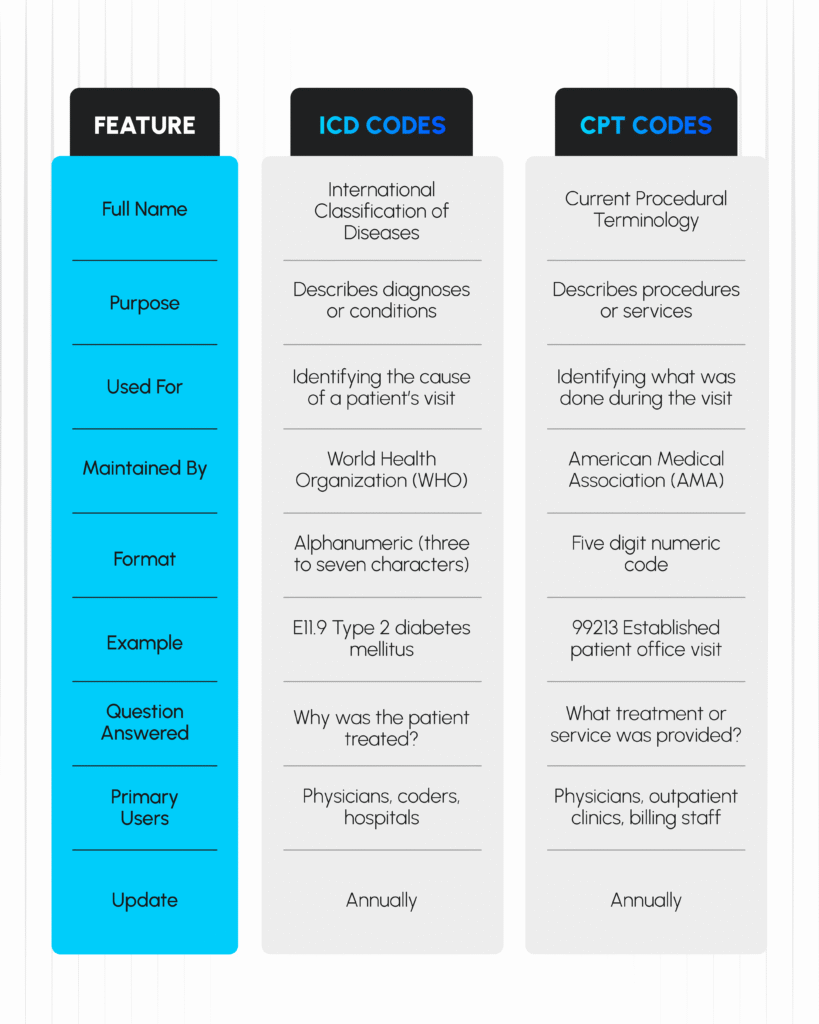
Using both codes correctly on claim helps insurance companies understand both the reason for care (ICD) and the service provided (CPT).
How ICD and CPT Codes Work Together?
When used together, ICD and CPT codes link the diagnosis to the treatment, providing a complete picture of a patient’s visit.
For instance,
- ICD code R07.0 identifies a patient with throat pain.
- CPT code 87880 documents that the doctor performed a rapid strep test to diagnose the cause.
Similarly,
- ICD code M25.561 indicates pain in the right knee.
- CPT code 20610 shows that an arthrocentesis or joint injection was performed.
Using these codes correctly ensures insurance companies clearly understand both the diagnosis and the treatment, which helps claims get processed accurately and faster.
Accurate coding is crucial, mistakes can lead to claim denials, delayed payments, and potential compliance issues. Professional assistance for denial management services is important for timely reimbursement.
Common Examples of ICD-10 and CPT Codes
In the healthcare industry, ICD-10 and CPT codes work hand in hand. ICD-10 codes describe diagnosis and CPT codes describe procedures. Together, they ensure accuracy in treatment documentation, reimbursement, and continuity of care.
Here are five common pairs you often encounter in a clinical setting:
Low Back Pain
- ICD-10 M54.5 indicates lower back pain.
- CPT 97140 represents manual therapy technique.
Both codes are used when addressing musculoskeletal pain through hands-on therapy and soft tissue mobilization.
Upper Respiratory Infection
- ICD-10 J06.9 indicates acute upper respiratory infection, unspecified.
- CPT 99213 code used for office or outpatient visit, established patient.
Both codes are frequently paired in primary health care visits for mild respiratory illnesses.
Type 2 Diabetes Mellitus
- ICD-10 E11.9 indicates type-II diabetes mellitus without complications.
- CPT 82947 highlights quantitative blood glucose tests.
Both codes paired to reflect routine diabetes management and glucose monitoring.
Hypertension
- ICD-10 I10 indicates primary hypertension.
- CPT 99214 code represents evaluation and management visit.
Together both codes highlight chronic condition follow-ups and blood pressure monitoring.
Knee Pain
- ICD-10 M25.561 indicates pain in the right knee.
- CPT 97110 represents therapeutic exercise.
Commonly used in physical therapy sessions to improve mobility and strength.
ICD-10-PCS vs CPT: For Inpatient Procedures
ICD-10-PCS is an acronym of International Classification of Diseases, Tenth Revision, Procedure Coding System. This system is specifically designed for inpatient and hospital settings.
ICD-10-PCS is an alphanumeric code consisting of seven characters. Each number and Letter carry specific information. The Seven characters represent the section, body system, root operation, body part, approach, device, and qualifier.
Example
- 027004Z: Dilation of Coronary Artery, One Site with Drug-eluting Intraluminal Device, Open Approach.
- 02704TZ: Dilation, Coronary Artery, One Site with Radioactive Intraluminal Device, Percutaneous Endoscopic Approach.
Healthcare professionals use ICD-10-PCS codes for inpatient procedures or services provided inside the hospital, whereas CPT codes are used for outpatient services. Both coding systems play a crucial role in medical billing. Even minor mistakes or inaccuracies can cause serious problems or legal consequences.
Why Accurate Coding Matters?
Accuracy in coding matters for a number of reasons listed below:
Fasten Reimbursement
As discussed earlier, ICD and CPT codes together tell the complete story of a patient’s care. Insurance companies review both codes during reimbursement, and accurate coding helps them to understand the need for the procedure and process payment faster.
Time Saving
Correct use of code saves time for both payers and providers, avoiding unnecessary delays.
Fewer Denials
Correct use of code helps reduce claim denial and supports compliance with payer policy.
Better Reporting
Consistent and correct coding allows health care organizations to analyze data and track performance efficiently.
To get the most out of your medical billing, take help from a professional medical coder.
Conclusion
Precise documentation is the foundation of smooth medical billing. Every diagnosis and procedure must be coded correctly to reflect the care provided and to ensure providers are reimbursed without delay. Consistency in coding not only reduces errors but also supports better communication between healthcare providers and payers.
For reliable results and seamless claim processing, consider working with Liberty Liens can help maintain accuracy and compliance at every step.