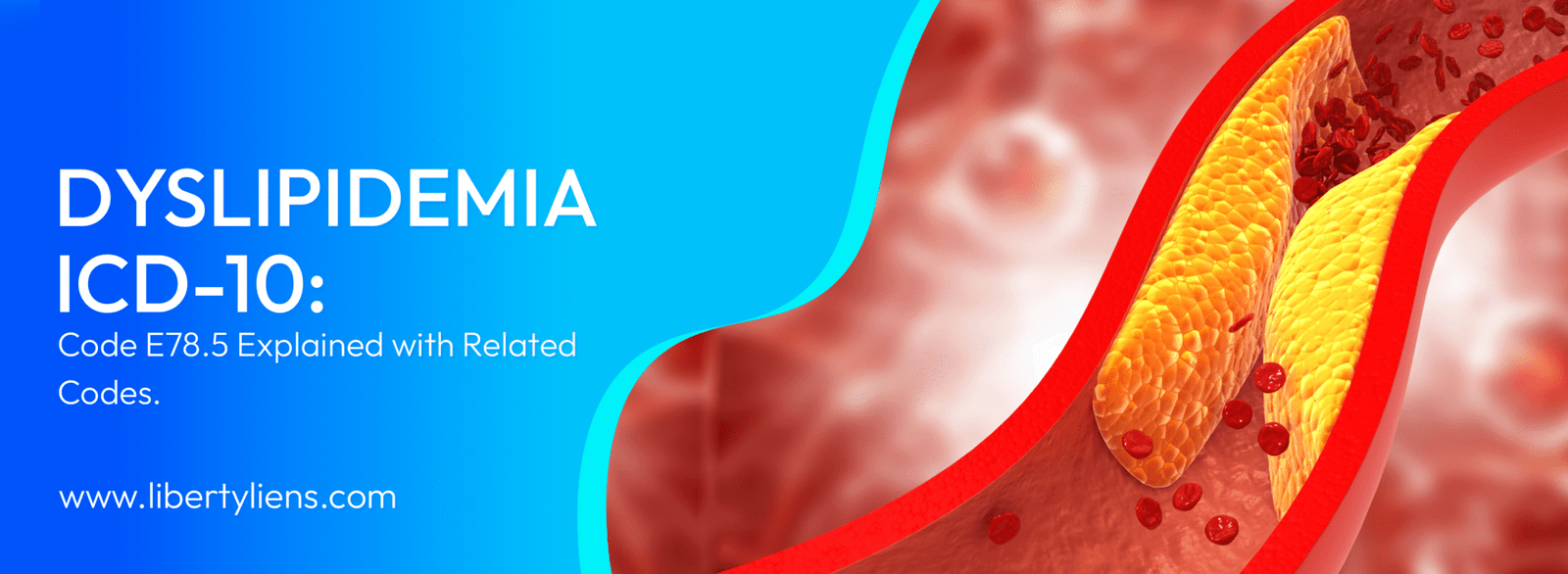
In busy clinical practices, many lipid-abnormality diagnoses are coded broadly, which can affect data quality, reimbursement, and long-term patient tracking. Studies show that for patients with documented abnormal lipids, up to 62 % lacked a corresponding diagnosis code in the electronic medical record.
For example, when you assign the “Hyperlipidemia, unspecified” (Dyslipidemia) code without specifying subtype, you may miss opportunities for precise risk stratification, and you increase the possibility of claim audits or denials.
Therefore, understanding the correct code set, whether you’re using the “icd 10 code for hyperlipidaemia,” the “icd 10 code for HLD,” or the “kode icd dyslipidaemia”, is crucial.
Key Dyslipidemia ICD 10 Codes at a Glance
Here are the important codes your practice should be familiar with in 2025.
Primary Codes
Condition / Diagnosis |
ICD-10 Code |
Notes for Documentation |
| Hyperlipidemia, unspecified | E78.5 | Use only when no subtype is documented. Avoid as default. |
| Pure hypercholesterolemia | E78.0 | For elevated LDL or total cholesterol only. |
| Pure hyperglyceridemia | E78.1 | For isolated elevated triglycerides. |
| Mixed hyperlipidemia | E78.2 | For both cholesterol and triglycerides elevated. |
| Other hyperlipidemia | E78.49 | For lipid disorders not classified elsewhere (e.g., elevated Lp(a)). |
| Familial hypercholesterolemia | E78.01 | For genetically confirmed or suspected familial cases. |
Related or Supporting Codes
Description |
Code |
When to Use |
| Elevated lipids (unspecified) | E78.5 | Same as “hyperlipidemia, unspecified.” |
| Elevated LDL (low-density lipoprotein) | E78.0 | Prefer specific term if documented. |
| Elevated triglycerides | E78.1 | Must have lab confirmation. |
| Other lipid metabolism disorders | E78.8 | Rare or atypical lipid patterns. |
| Unspecified disorder of lipoprotein metabolism | E78.9 | Avoid if labs specify pattern. |
Proper Documentation to Support Coding
To help ensure you select the most accurate code and avoid “ICD 10 hyperlipidaemia unspecified” versus a more specific code, follow this checklist:
- Lipid panel results: Document LDL, HDL, triglycerides, and total cholesterol.
- Clinical assessment: Note whether the patient has “mixed hyperlipidaemia,” “pure hypertriglyceridaemia,” or just “hypercholesterolaemia.”
- Treatment plan: What lifestyle changes, medications, or follow-up have you ordered?
- Risk association: Link to comorbidities – e.g., diabetes, metabolic syndrome, pancreatitis risk from hypertriglyceridaemia.
- Follow-up plan: When is the next lipid panel? How will you monitor, etc?
When any of these details are missing, the safest fallback becomes the icd 10 code for hyperlipidemia unspecified (E78.5). But when your documentation provides more clarity, it’s always better to assign a specific code such as E78.0 or E78.1. The same principle applies to other conditions—if a patient presents with nonspecific chest discomfort, you may initially use the icd 10 code for chest pain (R07.9) until further assessment identifies the exact cause.
Common Pitfalls Physicians Should Know
- Choosing “dx code e78.5” when lab results show elevated triglycerides and cholesterol both—should instead use E78.2.
- Recording “icd 10 for high cholesterol” but failing to indicate LDL versus HDL – leads to unspecified coding.
- Using “icd 10 code for hypertriglyceridaemia” without lab confirmation. Clinical documentation must match.
- Failing to update the code when subsequent labs/assessments clarify the lipid disorder subtype.
Note: “Avoid using E78.5 when more detailed information is available that would allow for coding a more specific type of hyperlipidaemia.”
Practical Scenarios & How to Code dyslipidemia, the Right Way
Scenarios |
Documentations |
| A patient has LDL = 160 mg/dL, HDL = 40 mg/dL, triglycerides normal. | “Pure hypercholesterolaemia (LDL elevated)” → Use E78.0 instead of just E78.5. |
| Patient has triglycerides = 550 mg/dL, cholesterol normal, no other lipid abnormalities. | “Hypertriglyceridaemia, not mixed” → Use E78.1. |
| Patient has LDL elevated & triglycerides elevated. | “Mixed hyperlipidaemia” → Use E78.2. |
| Lipid panel shows abnormal lipids but provider only notes “elevated lipids” without specifying type. | “Elevated lipids” without subtype → Use E78.5 (icd 10 code e78.5 dx code) but note you should aim to refine. |
| Lipid abnormality not covered by standard categories (e.g., Lp(a) elevation). | Use E78.49 “other hyperlipidaemia.” |
Summary of What We Have Learned So Far
For physicians managing patients with lipid disorders, accurate documentation ties directly to accurate coding. Whether you’re entering an “icd 10 code for dyslipidaemia” (or the Indonesian term “kode icd 10 dyslipidaemia”), or specifying “icd 10 code for hyperlipidaemia unspecified,” the rule remains: use the most specific code that matches your documentation.
Codes such as E78.0, E78.1, E78.2, E78.49 exist alongside E78.5—so defaulting to E78.5 should be a fallback, not a first choice.
Implementing workflow checks and educating your team will improve your data quality, reduce claim risk, and enhance patient population management.
If your practice does not yet have a built-in protocol to review lipid disorder documentation and link it to correct codes (e.g., “icd 10 for elevated triglycerides,” “mixed hyperlipidaemia code”), now is the time to connect with professional medical billing experts. Make that change, track your results, and ensure your coding reflects the high standard of care you deliver.