Preparing a patient for surgery involves much more than scheduling a date. Every planned procedure raises questions about medical stability, anesthesia risks, and whether chronic conditions are well-controlled enough for the operation to proceed safely. This is where preoperative clearance steps in and where accurate ICD-10 coding for preoperative clearance becomes crucial.
For medical professionals, these encounters require close attention to the purpose of the visit, the upcoming procedure, and the patient’s overall health profile. This guide breaks down the essentials of pre-op clearance ICD-10 coding, with detailed explanations, clinical examples, and documentation tips designed to raise accuracy and protect your claims from denials.
Preoperative Clearance Overview
A preoperative clearance, also called a pre-op assessment, presurgical evaluation, or surgical clearance visit, is a focused medical evaluation performed before a scheduled procedure. It is not a routine physical and not a general wellness update. The entire purpose is centered on the upcoming surgery. During this visit, the provider reviews the patient’s medical history, current symptoms, medication list, comorbidities, functional status, and any potential risks that include:
During this visit, providers look at:
- Cardiac risk
- Pulmonary stability
- Lab abnormalities
- Impact of chronic diseases
- Medication management
- Surgical and anesthesia risks
The purpose is not to diagnose a new condition but to determine whether the patient is stable enough to proceed safely.
Pre-operative evaluations are most often performed by:
- Primary care providers
- Cardiologists
- Pulmonologists
- Endocrinologists
- Other specialists involved in risk evaluation
When Preoperative Clearance Is Required
A preoperative evaluation is typically needed when:
- A patient is scheduled for elective surgery
- The surgeon requests medical, cardiac, pulmonary, or metabolic clearance
- A chronic condition may affect anesthesia
- A patient has a recent change in symptoms
- Insurance requires documented clearance before authorizing the procedure
- Pre-operative testing (labs, EKG, chest imaging) is planned
Not every surgery requires a full clearance, but anything involving anesthesia usually does.
Why ICD-10 Coding Plays a Central Role
Every part of the presurgical process, including clearance visits, testing, and specialty evaluations, is tied to diagnosis coding. Strong ICD-10 coding ensures:
- A clear link between the reason for the visit and the upcoming surgery
- Correct coverage of pre-op labs, imaging, or EKGs
- Fewer medical necessity denials
- Accurate risk documentation
- Communication between primary care, specialists, and surgeons
Missing or incorrect ICD-10 codes can delay surgeries, stop claims, or lead to unnecessary back-and-forth with payers.
The Key Preoperative ICD-10 Code: Z01.818
Z01.818 — Encounter for other preprocedural examination
This is the primary ICD-10 code for most preoperative clearance encounters.
Use Z01.818 when:
- The visit is specifically for preoperative evaluation
- The provider is assessing the patient’s readiness for surgery
- The goal is clearance or risk assessment
- The encounter is not primarily for managing a chronic disease
This code should lead the diagnosis list for a general pre-op medical evaluation.
Documentation Requirements for Z01.818
To support Z01.818, the chart should clearly identify:
- The planned surgery
Include procedure name and surgical specialty.
- Purpose of the visit
State that the exam is for preoperative medical evaluation.
- Assessment of chronic conditions
Document stability, control, and risk related to anesthesia.
- Any testing ordered
Labs, EKG, chest imaging, or specialty consultations.
Common ICD-10 Codes for Preoperative Clearance
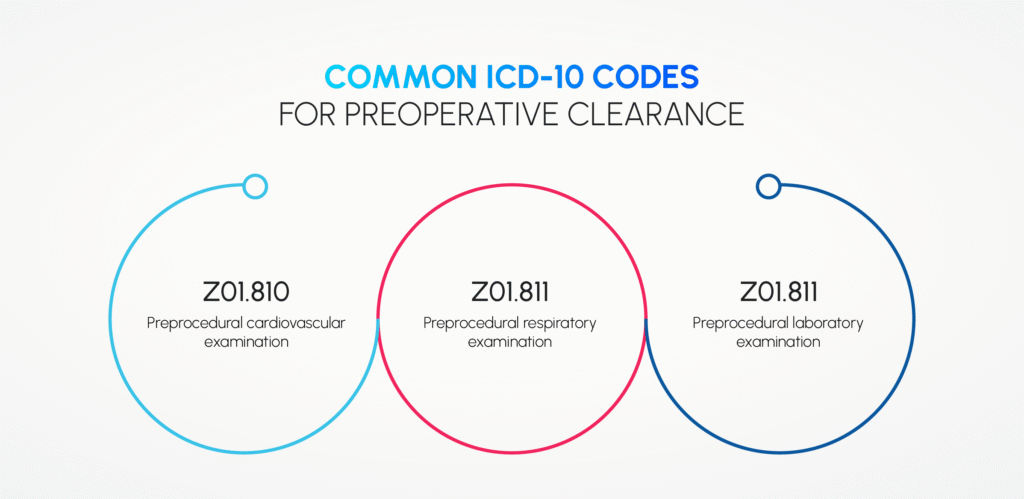
Not all preoperative evaluations fall under Z01.818. Many visits are focused on specific aspects of risk assessment, leading to the use of other preprocedural codes.
Z01.810 – Preprocedural cardiovascular examination
Used by cardiology or when the visit centers on cardiac risk.
Z01.811 – Preprocedural respiratory examination
Used when evaluating pulmonary status before surgery.
Z01.812 – Preprocedural laboratory examination
Used when the encounter is solely for pre-operative labs.
These codes can be used instead of Z01.818, depending on the provider’s documentation.
Coding the Condition Requiring Surgery
The ICD-10 code for the condition prompting surgery must also appear in the claim.
Examples:
- Knee osteoarthritis – M17.11, M17.12
- Cataract – H25.13
- Gallstones – K80.20
- Hernia – K40.90
This shows the medical necessity of the evaluation.
Coding Comorbidities That Affect Clearance
Preoperative assessments always involve a review of chronic conditions. Codes for these conditions must be included when they impact decision-making.
Examples:
- Type 2 diabetes – E11.9
- Hypertension – I10
- Coronary artery disease – I25.10
- COPD – J44.9
- Asthma – J45.909
- CKD – N18.30–N18.6
- Obesity – E66.9
These conditions influence the level of risk and justify the provider’s medical decision-making during the visit.
Preoperative Testing Codes
Preoperative testing is a core part of clearance. Medical professional should apply the correct Z-codes for tests performed:
- Z01.812 — Pre-op lab exam
- Z01.810 — Pre-op EKG / cardiovascular testing
- Z01.818 — General testing linked to clearance
- Z01.811 — Pulmonary evaluation for surgery
These codes help payers understand why the tests were performed.
Clinical Scenarios With Correct ICD-10 Coding
Scenario 1: Pre-op medical clearance for cataract surgery
A 70-year-old is evaluated by a primary care provider before cataract surgery.
Codes
- Z01.818
- H25.13 (reason for surgery)
- I10 (hypertension reviewed for risk)
Scenario 2: Cardiac clearance before joint replacement
A cardiologist evaluates a patient with Coronary Artery Disease (CAD) before knee replacement.
Codes
- Z01.810
- M17.11 (condition requiring surgery)
- I25.10 (coronary artery disease)
- E78.5 (lipid disorder)
Scenario 3: Pulmonary clearance for bariatric surgery
A pulmonologist assesses a patient with Chronic Obstructive Pulmonary Disease (COPD) before gastric sleeve surgery.
Codes
- Z01.811
- E66.01 (morbid obesity)
- J44.9 (COPD)
- R06.00 (dyspnea if documented)
Frequent Coding Errors and How to Avoid Them
1. Using Z01.818 as the only code
Always include the diagnosis that requires surgery.
2. Forgetting chronic conditions
These influence risk and support the provider’s assessment.
3. Assigning a chronic disease as the primary diagnosis
Preoperative clearance should be the main reason for the visit.
4. Missing specialty codes
Cardiology and pulmonology should use Z01.810 or Z01.811 when appropriate.
5. Coding pre-op clearance for urgent procedures
Preoperative clearance applies to scheduled procedures only
Improving Accuracy and Reducing Claim Denials
- Make sure documentation clearly states the patient is being seen for presurgical evaluation.
- Include the exact procedure and the surgical specialty.
- Capture all comorbidities reviewed or addressed.
- Use testing codes such as Z01.812 and Z01.810 appropriately.
- Train staff to double-check that the condition prompting surgery is included.
- Confirm whether clearance is granted, deferred, or pending further testing.
Strong documentation paired with correct ICD-10 coding ensures fewer delays and cleaner claims
Conclusion
Preoperative clearance visits play a major role in surgical planning, and the accuracy of ICD-10 coding directly affects patient safety, specialty communication, and reimbursement. Every medical professional working with preoperative evaluations must understand how Z01.818 fits into the documentation, how chronic conditions influence risk, and how to pair the correct diagnosis codes with testing and consultations. Solid coding supports smoother surgical workflows, fewer denials, and clearer communication among everyone involved in the patient’s care.
If you want external support for billing accuracy, Liberty Liens is an excellent resource. Their team helps practices strengthen documentation, resolve coding errors, and improve the speed of claim processing. Reliable follow-up and precise medical billing services can make a noticeable difference in surgical preparation cycles, especially for offices managing high patient volume.
Liberty Liens can help you reduce delays, improve compliance, and keep reimbursement on track, so your team can focus on patient care while they handle the revenue work behind the scenes.