
Managing the financial side of healthcare can feel like a full-time job on top of caring for patients. That’s where outsourcing revenue cycle management(RCM) comes in. Studies show that practices that outsource revenue cycle management can reduce administrative costs by 15 to 40% and receive payment faster, thereby eliminating the frustrating wait for reimbursements. One benefit of outsourcing RCM is that an organization’s denial rates can decrease by up to 20%, resulting in fewer headaches chasing claims and more predictable cash flow
It shows that revenue cycle management outsourcing is more than just a way to handle medical billing. It is a strategic move that can transform your operation, financial health, and patient experience. Let’s take a closer look at the key benefits of outsourcing RCM and why so many healthcare providers are choosing this approach.
Key Benefits of Outsourcing Your Revenue Cycle Management (RCM)
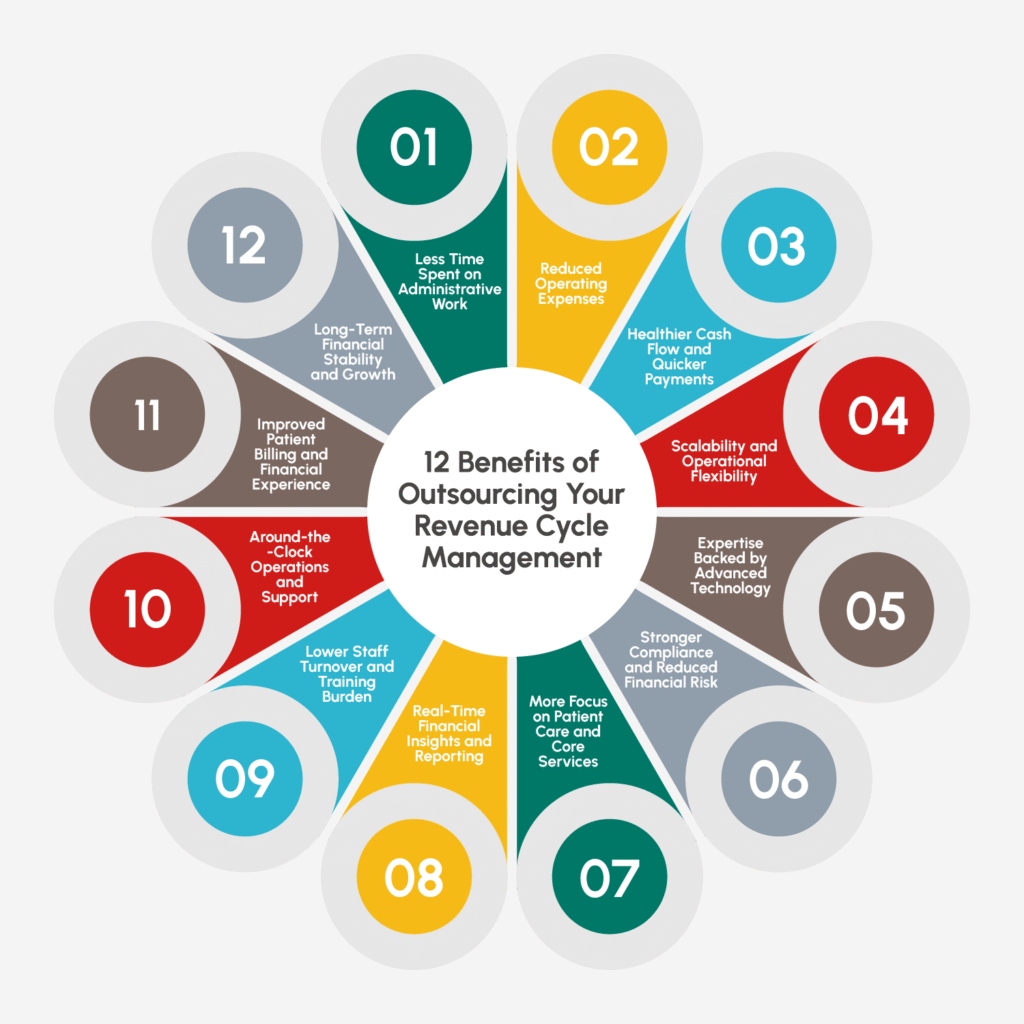
Understanding the benefits of outsourcing RCM helps healthcare providers see why so many practices are moving away from in-house billing.
1. Less Time Spent on Administrative Work
Outsourcing revenue cycle management significantly cuts down the administrative workload that often overwhelms healthcare staff. Tasks such as eligibility checks, medical coding, claims submission, and AR follow-ups require constant attention and precision. When these responsibilities are handled by an external revenue cycle management partner, internal teams can step away from repetitive paperwork. This not only improves productivity but also reduces stress and burnout among staff. With fewer administrative distractions, practices can operate more efficiently while ensuring that financial processes continue to run smoothly in the background.
2. Reduced Operating Expenses
Managing revenue cycle management in-house comes with high costs, including staff salaries, training, billing software, and compliance updates. Another important benefit of outsourcing RCM is shifts these fixed expenses into a more predictable service model. Practices can save money without compromising accuracy or performance. By eliminating the need for a large billing team and costly infrastructure, healthcare organizations can better control expenses. These savings can then be redirected toward patient care, facility upgrades, or technology investments that directly support clinical operations and long-term growth.
3. Healthier Cash Flow and Quicker Payments
Delayed payments can disrupt a practice’s financial stability. Outsourced revenue cycle management providers specialize in timely and accurate claim submission, reducing processing delays and errors that slow reimbursements. With dedicated teams monitoring claims and following up consistently, payments arrive faster and more reliably. Improved cash flow helps practices cover operational costs, manage payroll, and plan for future investments. Faster reimbursements also reduce the stress of unpredictable revenue cycles, allowing leadership to make more confident financial decisions.
4. Scalability and Operational Flexibility
As healthcare practices grow, managing billing internally becomes increasingly complex. Outsourcing revenue cycle management provides the flexibility to scale operations without adding internal staff or infrastructure. Whether patient volumes increase, services expand, or new locations open, an RCM partner can adjust resources accordingly. This scalability ensures that growth does not strain existing teams or slow down financial processes. Practices gain the freedom to expand at their own pace, knowing their revenue cycle can handle changing demands efficiently.
5. Expertise Backed by Advanced Technology
Revenue cycle management providers bring specialized knowledge and advanced billing technology that many practices cannot maintain in-house. Their teams stay updated on coding changes, payer requirements, and best practices, while using automation and analytics tools to improve accuracy and efficiency. This combination reduces errors, improves claim acceptance rates, and enhances overall performance. Outsourcing allows practices to benefit from expert-level support and cutting-edge systems without the cost or complexity of managing them internally.
6. Stronger Compliance and Reduced Financial Risk
Healthcare billing is heavily regulated, and compliance mistakes can lead to audits, penalties, or lost revenue. Outsourced revenue cycle management teams stay current with changing regulations, coding standards, and payer rules. Their expertise helps ensure that claims are compliant and documentation meets required standards. This proactive approach reduces legal and financial risk while protecting the practice’s reputation. With compliance managed by experts, providers can focus on care delivery without constant concern about regulatory errors.
7. More Focus on Patient Care and Core Services
When billing and revenue management are handled externally, healthcare providers can refocus on what they do best, which means delivering quality care. Physicians and staff spend less time dealing with financial issues and more time with patients. This shift improves clinical efficiency, patient satisfaction, and staff morale. By removing financial distractions, practices can strengthen their core services, improve outcomes, and create a more patient-centered environment without sacrificing financial performance.
8. Real-Time Financial Insights and Reporting
Outsourced RCM providers offer real-time analytics and detailed financial reports that give practices better visibility into performance. These insights include denial trends, payment timelines, and revenue gaps. Access to accurate data helps leadership identify issues early and make informed decisions. Instead of relying on outdated or incomplete reports, practices gain a clear picture of their financial health, enabling continuous improvement and smarter long-term planning.
9. Lower Staff Turnover and Training Burden
Billing roles often experience high turnover due to complexity, workload, and constant regulatory changes. Outsourcing RCM reduces dependence on in-house billing staff, minimizing recruitment and training challenges. Practices no longer need to invest heavily in ongoing education or worry about knowledge gaps when staff leave. This stability helps maintain consistent performance while allowing internal teams to focus on patient-facing roles that directly support care delivery.
10. Around-the-Clock Operations and Support
Many outsourced RCM providers offer extended working hours or round-the-clock operations. This ensures claims processing, follow-ups, and issue resolution continue beyond standard office hours. Extended coverage prevents backlogs, speeds up denial management, and improves overall efficiency. Practices benefit from continuous progress in their revenue cycle, even when internal teams are offline, resulting in faster turnaround times and smoother financial operations.
11. Improved Patient Billing and Financial Experience
A smooth billing process plays a major role in patient satisfaction. Outsourced RCM providers help ensure accurate statements, timely communication, and clear explanations of charges. This reduces confusion, billing disputes, and patient frustration. When patients understand their financial responsibilities and experience fewer errors, trust in the healthcare provider improves. A positive financial experience complements quality care and strengthens long-term patient relationships.
12. Long-Term Financial Stability and Growth
Consistent cash flow, reduced denials, and expert financial oversight contribute to long-term stability. Outsourcing RCM helps practices build a strong financial foundation that supports sustainable growth. With predictable revenue and fewer operational risks, healthcare organizations can invest confidently in staff, technology, and service expansion. This stability allows practices to adapt to industry changes while continuing to deliver high-quality care.
When you look at these advantages together, the overall benefit of outsourcing revenue cycle management becomes hard to ignore.
If you are interested in knowing more about RCM, you can also read about the Best Revenue Cycle Management Software
Conclusion
At the end of the day, the benefit of outsourcing revenue cycle management goes far beyond improving numbers on a financial report. It reduces administrative strain, strengthens cash flow, and allows healthcare teams to focus more on patient care instead of billing challenges. With expert oversight, fewer denials, and more predictable revenue, outsourcing RCM provides the stability and confidence practices need to grow, adapt, and deliver better experiences for both staff and patients in an increasingly complex healthcare environment.
Liberty Liens is a trusted revenue cycle management (RCM) provider dedicated to helping healthcare practices simplify billing, reduce denials, and get paid faster. With expert teams and proven RCM solutions, Liberty Liens allows providers to focus on patient care while we take care of the revenue.