What Is CPT Code 36415?
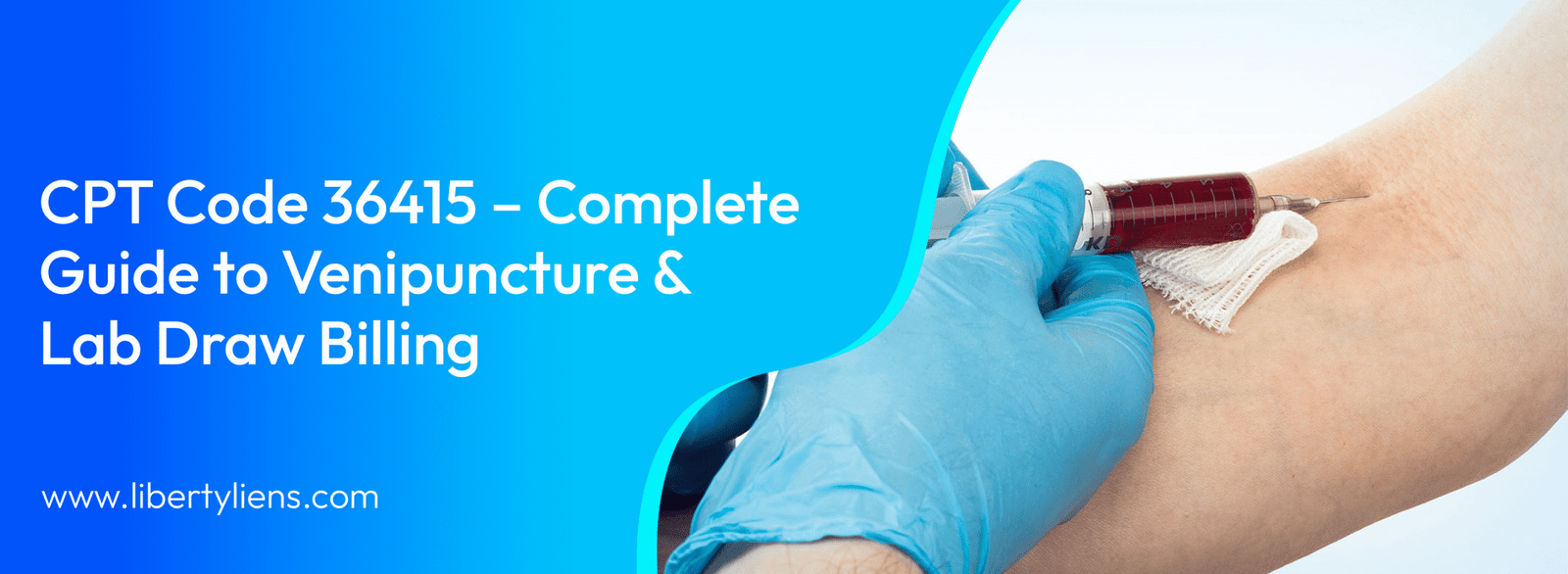
CPT code 36415 is one of the most frequently used procedural codes in clinical medicine. It is defined by the American Medical Association (AMA) as the collection of venous blood by venipuncture. In simpler terms, it is the standard CPT code used when a phlebotomist or clinical staff member draws blood from a vein using a needle — commonly referred to as a lab draw or blood draw.
This code falls under the Surgery section of the CPT manual, specifically within the Cardiovascular System subsection covering vascular injection procedures. Despite its surgical classification, CPT 36415 is used routinely across virtually every medical setting — from primary care offices and urgent care clinics to hospital outpatient departments and independent laboratories.
Accurate use of the CPT code 36415 is essential for proper reimbursement and claim compliance. Miscoding a venipuncture or failing to include it when appropriate can lead to revenue loss or claim denials — challenges that Liberty Liens’ Medical Billing Services team is specifically equipped to resolve.
CPT Code 36415 Description
The official CPT code 36415 description as defined by the AMA is:
“Collection of venous blood by venipuncture”
This description covers the routine collection of blood from a peripheral vein. The code applies when clinical staff punctures a vein using a needle and evacuated tube system (such as a Vacutainer) to collect a blood specimen for diagnostic laboratory testing.
It is important to understand what this code does not include:
- It does not cover the laboratory tests themselves (those are billed separately under their respective lab CPT codes).
- It does not apply to arterial blood draws or capillary (fingerstick) collection.
- It does not include any interpretation of results.
For fingerstick or capillary blood collection, a separate code — CPT code 36416 — is used. Understanding this distinction is critical for avoiding billing errors and claim rejections.
HCPCS 36415 – Is There a Difference?
The term HCPCS 36415 is sometimes used interchangeably with CPT 36415. While CPT (Current Procedural Terminology) codes are published by the AMA, HCPCS (Healthcare Common Procedure Coding System) is the broader system used by Medicare and Medicaid. CPT codes form Level I of the HCPCS system, meaning CPT 36415 and HCPCS 36415 refer to the same code.
This distinction matters for billing purposes — particularly when submitting claims to Medicare, Medicaid, or Workers’ Compensation payers. Liberty Liens’ Eligibility & Benefits Verification Services ensure that each claim is formatted and coded correctly for the specific payer, reducing the risk of rejections based on coding system mismatches.
CPT Code 36416 Description – Understanding the Difference
While CPT 36415 covers routine venipuncture, CPT code 36416 covers a different type of blood collection:
CPT 36416 Description: Collection of capillary blood specimen (e.g., fingerstick, heelstick, earstick)
The key differences between 36415 and 36416 are:
| Feature | CPT 36415 |
CPT 36416 |
| Collection Method | Venipuncture (needle into vein) | Capillary puncture (fingerstick/heelstick) |
| Patient Population | Adults, children, infants (vein access) | Neonates, pediatric, point-of-care testing |
| Common Settings | Labs, clinics, hospitals | POC testing, nurseries, home health |
| Reimbursement | Generally higher | Generally lower |
Understanding when to use 36415 versus 36416 is a routine but important billing decision that can significantly impact reimbursement accuracy across high-volume practices.
CPT Code 36410 – When Is It Used Instead?
CPT 36410 is another venipuncture code, but it applies specifically to a more complex or difficult venipuncture — one that requires the skill of a physician or other qualified health care professional (not a routine lab draw by a phlebotomist).
CPT 36410 Description: Venipuncture, age 3 years or older, necessitating physician’s skill (separate procedure), for diagnostic or therapeutic purposes (not to be used for routine venipuncture)
The critical distinction is that CPT 36410 is reserved for medically necessary, physician-level venipuncture, while CPT 36415 covers routine collection performed by clinical staff. Incorrect use of 36410 in place of 36415 — or vice versa — is a common audit target and can trigger claim denials or compliance scrutiny.
Liberty Liens’ Denial Management Services specialize in identifying and correcting these types of coding errors before they escalate into significant revenue loss.
CPT for Lab Draw – When and How to Bill It
The CPT for lab draw or CPT code for lab draw (36415) is billed by the entity that physically collects the blood specimen. This is an important nuance:
- If the physician’s office staff draws the blood, the physician’s office bills CPT 36415.
- If the patient goes to a standalone laboratory (e.g., Quest Diagnostics, LabCorp) for the draw, the laboratory bills 36415.
- If the blood is drawn in a hospital outpatient setting, the hospital typically bills the code.
Key billing rules for CPT 36415:
- Medicare reimbursement: Medicare reimburses CPT 36415 at a relatively low flat rate (typically around $3–$5 under the Clinical Laboratory Fee Schedule), but consistent accuracy ensures these payments are not missed at scale.
- Modifier usage: Modifiers are generally not required for routine venipuncture billing under 36415, though specific payer policies may vary.
- Place of Service (POS): The correct POS code must accompany the claim — POS 11 (office), POS 22 (outpatient hospital), POS 81 (independent laboratory), etc.
- Diagnosis codes: CPT 36415 must be linked to an appropriate ICD-10 diagnosis code justifying the lab order (e.g., Z01.89 for routine blood work or specific condition codes).
- Bundling rules: CPT 36415 is generally not bundled with the laboratory test codes themselves, meaning it can be billed separately alongside the individual test codes.
Practices that perform high volumes of lab draws — including Primary Care, Family Medicine, Internal Medicine, and Cardiology — must ensure that this code is consistently captured and correctly billed to avoid revenue leakage.
Which Specialties Commonly Use CPT 36415?
CPT 36415 is one of the most universally used codes across medicine. However, certain specialties rely on it with particular frequency:
Primary Care & Family Medicine – Routine annual wellness labs, chronic disease monitoring (diabetes, hypertension, thyroid), and preventive screenings make CPT 36415 a high-volume code. See Liberty Liens’ Family Medicine Billing Services and Primary Care Billing Services.
Internal Medicine – Patients with complex, multi-system conditions require frequent lab monitoring. Liberty Liens’ Internal Medicine Billing Services ensure these draws are billed accurately every time.
Cardiology – Lipid panels, BNP, troponin, coagulation studies, and metabolic panels are standard in cardiac care. Learn more about Cardiology Billing Services.
Pain Management – Urine drug screening is common, but blood draws for medication monitoring also occur regularly. Visit Pain Management Billing Services.
Neurology – Labs for seizure medication levels, autoimmune panels, and metabolic workups. See Neurology Billing Services.
Podiatry – Pre-surgical labs and diabetic wound care panels. Learn about Podiatry Billing Services.
General Surgery – Pre-operative and post-operative labs are standard. Visit General Surgery Billing Services.
Home Health Care – Nurses performing home visits often collect blood specimens billed under 36415. Liberty Liens supports Home Health Care Billing Services.
Wound Care – Labs to assess infection markers, albumin, and nutritional status are routine. See Wound Care Billing Services.
Common Billing Errors with CPT 36415
Even with a straightforward code like 36415, billing errors occur frequently. The most common include:
- Failing to bill 36415 at all – Many practices, especially those that send specimens to an outside lab, assume the lab will bill the draw fee. If your staff collected the specimen, your practice is entitled to bill 36415.
- Using 36410 instead of 36415 – As described above, 36410 is for physician-level complex venipuncture only. Routine lab draws must use 36415.
- Incorrect Place of Service – Billing POS 11 (office) when the draw occurred in a hospital outpatient setting can result in claim denial.
- Missing or mismatched diagnosis codes – Every claim for CPT 36415 must have a supporting ICD-10 code that reflects the medical reason for the blood draw.
- Duplicate billing – Billing 36415 and 36416 for the same patient encounter without clear clinical justification for both collection types.
Liberty Liens’ AR Follow-Up Services and Denial Management teams routinely recover revenue from denied or underpaid venipuncture claims across all payer types — including Medicare, Medicaid, commercial insurers, and Workers’ Compensation carriers.
CPT 36415 in Workers’ Compensation Cases
In Workers’ Compensation cases, laboratory testing — and by extension, venipuncture — may be ordered to evaluate the extent of a workplace injury, monitor medication levels for pain management, or assess overall health as part of a treatment plan.
When billing CPT 36415 under Workers’ Compensation, it is essential to:
- Reference the correct claim number and date of injury on the claim.
- Ensure the lab draw is directly tied to the work-related diagnosis.
- Follow state-specific Workers’ Compensation fee schedule rates (which differ from Medicare rates).
Liberty Liens specializes in Workers’ Compensation Billing Services and understands the nuanced requirements of WC payers across California and beyond. Our team ensures that every procedural code — including 36415 — is accurately submitted and aggressively followed up.
How Liberty Liens Supports Accurate Lab Draw Billing
At Liberty Liens, we understand that codes like CPT 36415 may appear simple, but billing them correctly and consistently across hundreds or thousands of patient encounters requires systematic precision.
Our Medical Billing Services include:
- Medical Coding – Accurate CPT and ICD-10 code assignment for all procedure types, including lab draws and venipuncture.
- Claim Submission – Clean, compliant claims submitted within 24–48 hours of receiving documentation.
- Eligibility Verification – Confirming payer coverage before billing to reduce rejections.
- Denial Management – Identifying denial patterns, correcting errors, and resubmitting claims for maximum reimbursement.
- Payment Posting – Accurate and timely posting of all remittances.
- AR Follow-Up – Proactive follow-up on all outstanding claims.
- Credentialing – Ensuring providers are properly enrolled with payers to avoid billing roadblocks.
Whether you are a solo primary care physician, a multi-specialty clinic, or a large healthcare system, Liberty Liens delivers the billing precision and revenue cycle expertise your practice needs.
Conclusion
CPT code 36415 — the routine venipuncture code — is foundational to laboratory billing across all clinical settings. Though it represents a single, routine procedure, accurate and consistent billing of this code across high-volume practices can represent substantial cumulative revenue. Understanding its description, proper use, distinctions from related codes like 36416 and 36410, and payer-specific rules is essential for every billing professional and medical practice administrator.
If your practice is experiencing underpayments, denials, or revenue gaps related to lab draw billing or any other CPT codes, Liberty Liens is here to help.
Contact Liberty Liens today or Book a Free Consultation to learn how our expert billing team can optimize your revenue cycle — starting with the very first needle stick.