The Growth Dilemma Every Medical Practice Faces
Whether you are a solo practitioner just opening your doors or a multi-physician group practice looking to expand, you have likely grappled with a deceptively simple question: networking vs. marketing, which strategy should I use to grow?
For most physicians and healthcare administrators, the instinct is to invest in marketing like run ads, build a website, post on social media. But seasoned healthcare professionals often discover that their most valuable referrals and partnerships did not come from a Facebook campaign or a Google Ad. They came from a colleague met at a medical conference, a hospital administrator connected with at a community health event, or a specialist who remembered them from residency years ago.
This brings us to one of the most important strategic distinctions in medical practice growth: networking vs. marketing. These two disciplines are frequently confused, often conflated, and almost always under-leveraged, especially in healthcare, where trust, reputation, and relationships are the currency of success.
In this comprehensive guide, we break down the key differences between networking and marketing for doctors and medical practices, explain why both are essential, and show you how to build a strategy that harnesses the full power of each.
What Is Medical Marketing? A Comprehensive Overview
Medical marketing refers to the strategic, often paid or structured effort to promote your practice, services, and brand to prospective patients and the broader public. It is the outward-facing, message-driven activity designed to attract attention, generate inquiries, and convert prospects into patients.
Core Components of Medical Marketing
1. Digital Marketing
Digital Marketing sits at the forefront of modern practice promotion. This includes search engine optimization (SEO) to ensure your practice appears at the top of Google when a patient searches “cardiologist near me” or “family doctor accepting new patients.” It also encompasses pay-per-click advertising, social media marketing across platforms like Facebook, Instagram, and LinkedIn, email campaigns, and content marketing through blogs, videos, and educational resources.
2. Traditional Marketing
Traditional Marketing remains relevant in healthcare despite the digital revolution. Print advertising in local newspapers, magazines, and directories, radio and television spots, direct mail campaigns, community sponsorships, and billboard advertising all continue to drive patient awareness, particularly among older demographics who may rely less on digital channels.
3. Reputation Marketing
Reputation Marketing is uniquely critical in medicine. Online reviews on platforms such as Google, Healthgrades, Zocdoc, and Yelp directly influence whether a prospective patient chooses your practice. Research from the healthcare industry shows that more than 80% of patients consult online reviews before selecting a healthcare provider. Actively managing and responding to reviews, soliciting feedback from satisfied patients, and maintaining a stellar digital reputation is a form of marketing no modern practice can afford to ignore.
4. Practice Branding
Practice Branding encompasses the visual identity, tone, and messaging that define how your practice is perceived. This includes your logo, website design, the language in patient communications, your mission statement, and the overall feel of your practice from the first phone call to the post-visit follow-up.
What Marketing Does Well?
Marketing excels at scale and visibility. A well-optimized website can attract hundreds of new patient inquiries per month. A targeted Facebook ad campaign can put your practice in front of thousands of people in your geographic area in a matter of days. Marketing creates awareness. It puts your name in front of people who have never heard of you and gives them a reason to choose you.
Marketing is also highly measurable. You can track impressions, click-through rates, conversion rates, cost per acquisition, and return on investment with considerable precision. This data-driven dimension allows practices to test, refine, and optimize their campaigns over time.
The Limitations of Marketing Alone
However, marketing has real limitations in the healthcare context. Patients trust doctors, not ads. A billboard or a pay-per-click ad can create awareness, but it cannot build the kind of deep professional trust that drives consistent referrals, long-term patient loyalty, and institutional credibility. Marketing is expensive, and in competitive urban markets the cost of digital advertising for healthcare practices has risen dramatically. Furthermore, marketing reaches prospective patients, but many of the most valuable growth opportunities in healthcare come not from patients, but from other professionals.
If you are also struggling to decide between Billing Automation vs. Outsourcing, read our quick guide on Billing Automation vs. Outsourcing: Which Actually Increases Revenue for Your Practice
What Is Medical Networking? Redefining Professional Connection
Medical networking is the deliberate process of building and maintaining meaningful professional relationships with other physicians, specialists, hospital administrators, insurance representatives, healthcare organizations, community leaders, and other stakeholders in your professional ecosystem.
Networking is not simply handing out business cards at a conference. Done well, it is a sustained, relationship-centered strategy built on mutual value, genuine engagement, and long-term thinking.
The Forms Medical Networking Takes
1. Physician Referral Networks
Physician Referral Networks are among the most powerful growth drivers in healthcare. When a primary care physician trusts a cardiologist enough to routinely refer their patients, that relationship is worth thousands of dollars in annual revenue and it was built through networking, not marketing. Cultivating strong referral relationships with complementary specialists, primary care physicians, urgent care providers, and allied health professionals should be a cornerstone of any practice’s growth strategy.
2. Hospital and Health System Relationships
Hospital and Health System Relationships are essential for specialists, surgeons, and hospital-based physicians. Building relationships with hospital administrators, department heads, and committee members opens doors to staff privileges, departmental leadership roles, and collaborative care agreements that can dramatically expand a practice’s reach and prestige.
3. Professional Associations and Medical Societies
Professional Associations and Medical Societies offer structured networking environments where physicians connect with peers, share clinical insights, and build reputations within their specialty communities. Active participation in organizations such as the American Medical Association (AMA), specialty-specific boards, and state and local medical societies positions physicians as engaged, respected members of their professional community.
4. Community and Corporate Health Partnerships
Community and Corporate Health Partnerships involve building relationships with employers, school districts, nonprofit organizations, and community health initiatives. A pediatric practice that partners with local school districts for screenings and immunization programs, or an occupational medicine group that contracts with large employers for employee health services, has leveraged networking into a sustainable and scalable revenue stream.
5. Healthcare Thought Leadership Networking
Healthcare Thought Leadership Networking involves positioning yourself as an authority in your field through speaking engagements, conference presentations, academic publications, and media appearances. This form of networking blends into personal branding and has the dual effect of building professional credibility and attracting both referrals and direct patient interest.
What Networking Does Well
Networking builds trust, credibility, and long-term relationships that marketing simply cannot replicate. A colleague who has worked alongside you, seen your clinical judgment in action, and respects your character will refer their patients to you with confidence and those referred patients arrive already predisposed to trust you. This creates a dramatically higher patient lifetime value than a cold patient acquired through advertising.
Networking also opens doors that money cannot buy: speaking opportunities, board positions, journal editorships, partnership discussions, and collaborative research opportunities all emerge from strong professional networks, not from marketing campaigns.
The Limitations of Networking Alone
Networking, however, has its own limitations. It is slow. Building genuine professional relationships takes months and years, not days. Networking alone cannot rapidly scale a new practice’s patient volume, introduce your brand to a broad geographic audience, or capture the attention of the majority of patients who begin their search for a doctor online. Without marketing amplifying your brand, even the most well-connected physician may have a limited public profile.
Networking vs. Marketing at a Glance
|
Dimension |
Marketing | Networking |
| Primary Goal | Attract new patients & build brand awareness | Build professional relationships & referral pipelines |
| Time Horizon | Short to medium term | Medium to long term |
| Primary Audience | Prospective patients and the public | Colleagues, institutions & healthcare stakeholders |
| Cost Structure | Financial investment (ads, content, design) | Time and relationship investment |
| Measurability | Highly measurable (analytics, ROI) | Qualitative and relationship-based |
| Trust Factor | Lower — patients see through promotional messaging | Higher — built on personal and professional credibility |
| Scalability | High — digital marketing can scale rapidly | Limited — relationships require personal attention |
| Best For | Patient acquisition, brand visibility, reputation | Referrals, institutional growth, professional authority |
Why Medical Practices Need Both? And How They Work Together
The most successful medical practices do not choose between networking and marketing. They integrate both into a unified growth strategy where each discipline amplifies the other.
| Case in Point (Example)
A newly established orthopedic surgery group invests in a high-quality website with strong SEO and runs targeted Google Ads for common procedures. These marketing efforts generate a steady stream of patient inquiries. Meanwhile, the lead surgeon attends regional medical association meetings, builds relationships with primary care physicians across the region, and speaks at a local hospital’s grand rounds. These networking efforts generate a consistent flow of professional referrals. Together, marketing and networking fill the practice’s schedule from two entirely different directions, each reinforcing the other. |
Integration Strategies That Work
- Leverage Your Network to Amplify Your Marketing. Share your content. Be it blog posts, videos, research summaries with your professional network. Your network becomes a powerful distribution channel for your marketing content.
- Use Marketing to Support Your Networking. Before attending a conference or professional meeting, ensure your LinkedIn profile, practice website, and Google Business Profile are polished and up to date. Your marketing materials serve as your calling card in networking environments.
- Build a Referral Marketing System. Create a formal, structured system for nurturing referral relationships, consistent communication, educational updates, and appreciation initiatives. This all should be supported by professional marketing materials.
- Thought Leadership as a Bridge. Publishing articles, hosting webinars, contributing to medical publications, and speaking at events simultaneously builds your professional network and enhances your public marketing profile. It is one of the most powerful intersections of both disciplines.
Special Considerations for Different Practice Types
Primary Care and Family Medicine
For primary care physicians, direct patient marketing is essential — local SEO, community advertising, and online reputation management directly fill appointment books. Networking with specialists for reciprocal referral relationships and community organizations for health programs adds institutional depth and patient volume over time.
Specialists and Surgical Practices
Specialists depend heavily on referral networks from primary care physicians and other specialists. While patient-facing marketing matters for brand recognition, the most impactful growth strategies for specialists center on networking: building referral pipelines, hospital relationships, and professional reputation. Marketing supports and amplifies these efforts.
Group Practices and Health Systems
Larger organizations must invest in both at scale. Marketing departments handle brand management, patient acquisition, and digital strategy. Leadership and physicians simultaneously engage in networking at industry, policy, and community levels to drive institutional partnerships, attract talent, and position the organization within regional and national healthcare conversations.
Concierge Medicine and Direct Primary Care
Practices operating on a direct-pay or membership model rely intensely on trust-based marketing and hyper-local networking. Word-of-mouth — fueled by exceptional patient experiences and active community engagement — is often the primary growth engine, supported by polished digital marketing to give prospective members the confidence to convert.
Telehealth and Digital Health Practices
Digital health practices may operate across large geographic footprints and rely more heavily on digital marketing for patient acquisition. However, networking with insurance companies, employer health programs, digital health accelerators, and healthcare technology organizations remains a critical path to institutional growth and partnership development.
Bonus read: How Much Do Personal Injury Chiropractors Earn in 2026?
Common Mistakes Medical Practices Make
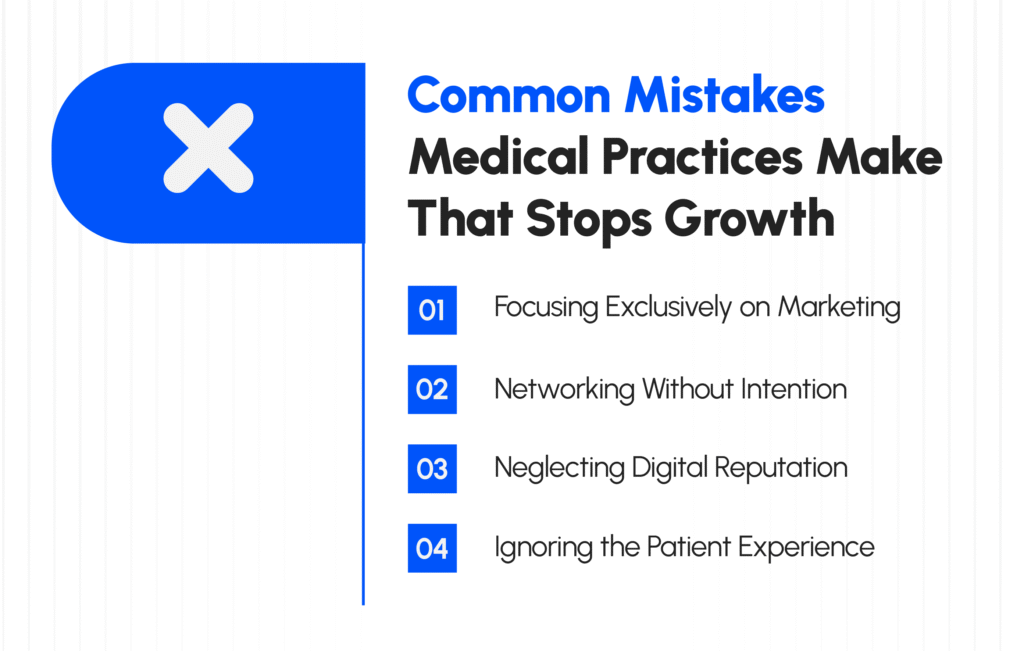
1. Focusing Exclusively on Marketing
Focusing Exclusively on Marketing leads practices into an expensive, diminishing-returns cycle. When all growth is driven by paid advertising, the practice is perpetually dependent on ad spend with no organic foundation. Networking creates durable, self-reinforcing growth that continues even when the marketing budget is reduced.
2. Networking Without Intention
Attending events and collecting contacts without a follow-up strategy wastes time and misses opportunities. Effective networking requires a plan: clear goals, consistent follow-up, and genuine relationship cultivation.
3. Neglecting Digital Reputation
Neglecting Digital Reputation is a critical error in the age of online review platforms. Even the most well-networked physician loses patients to competitors if their online reputation is poor. Marketing and networking must be supported by an active reputation management strategy.
4. Ignoring the Patient Experience
Ignoring the Patient Experience is perhaps the most counterproductive mistake of all. No marketing campaign and no professional network can compensate for a practice that delivers a poor patient experience. Word-of-mouth and the intersection of marketing and networking is ultimately driven by what happens inside your practice.
Are You Ready to Build a Networking and Marketing Strategy That Actually Works?
Liberty Liens is your dedicated partner for physician networking and medical practice marketing.We specialize in helping doctors, specialists, group practices, and healthcare organizations build the integrated growth strategies they need to thrive in today’s competitive healthcare environment. From professional referral network development and physician liaison programs to digital marketing strategy, online reputation management, and thought leadership positioning, Liberty Liens delivers the expertise, relationships, and execution that medical practices need to grow with confidence. We understand that your time is your most valuable asset. That is why our approach is designed to maximize your growth while minimizing the time you spend away from what matters most — your patients. Contact Liberty Liens today to schedule a complimentary practice growth consultation. Connecting Medical Professionals. Building Thriving Practices. |
The Integrated Growth Strategy for Today’s Medical Professionals
In the modern healthcare landscape, growth is not a binary choice between networking and marketing. It is the intelligent, deliberate integration of both disciplines into a cohesive strategy tailored to your practice’s specialty, market, and goals.
Networking builds the relationships, trust, and professional authority that marketing alone can never achieve. Marketing amplifies your reach, attracts the patients your network cannot, and gives your professional reputation a polished, public face. Together, they form the foundation of sustainable, long-term practice growth.
The most successful physicians and medical organizations understand this. They invest in their professional relationships with the same discipline and intentionality that they invest in their marketing campaigns — recognizing that every conference attended, every colleague mentored, every article published, and every community event participated in is an investment in their practice’s future.