Osteoporosis, often called the silent disease, affects millions worldwide, yet many remain unaware until a fracture occurs. Research from the International Osteoporosis Foundation estimates that nearly 200 million people suffer from osteoporosis, with one in three women and one in five men over 50 experiencing an osteoporotic fracture during their lifetime. This condition weakens bones by reducing bone mass and density, making them fragile and prone to breaks, particularly in the hip, spine, or wrist.
Beyond understanding the disease itself, ICD-10 coding for Osteoporosis is critical in clinical care, research, and healthcare management. The ICD-10 system provides a structured way to classify osteoporosis, differentiating between cases with or without fractures and identifying the underlying cause, such as age-related bone loss, medication use, or reduced physical activity. Proper coding allows healthcare providers to communicate patient status clearly, guide treatment, track outcomes, and ensure accurate medical billing and coding.
In this blog, we explore osteoporosis, its risk factors, the ICD-10 coding structure for osteoporosis, and common challenges, helping doctors and healthcare professionals manage the condition effectively and accurately.
What is Osteoporosis?
Osteoporosis, or commonly known as porous bone, is a skeletal disease that makes bones weak by reducing bone mass or density. It is developed due to a change in bone activity. Bones also go through the cycle known as bone remodeling, in which Osteoclasts are responsible for breaking down old cells, and Osteoblasts are responsible for making new cells. When the number of osteoclasts increases, the bones become thin and weak. According to the research, females are more prone to develop osteoporosis, but men and younger individuals also tend to develop it.
Risk Factors Linked with Osteoporosis
Osteoporosis occurs due to various factors such as aging ( osteoblast activity reduces with age), hormonal imbalance, especially estrogen levels in females can disturb activity, vitamins and minerals deficiency, and a sedentary lifestyle also play a major role because they reduce osteoblast stimulation. Osteoporosis is asymptomatic in nature, which is why it is called a silent disease.
What does Osteoporosis ICD-10 mean?
Osteoporosis ICD-10 refers to the coding system used to classify osteoporosis for medical documentation and reporting. These codes help describe a patient’s bone health by indicating whether bones have become fragile enough to result in fractures and by identifying contributing factors such as aging, medication use, or reduced physical activity. This structured approach allows healthcare providers to communicate a patient’s condition clearly and select appropriate care.
The primary ICD-10 codes for osteoporosis include M81.0, which represents age-related osteoporosis without a current fracture, and M80.0, which indicates osteoporosis with a current pathological fracture. These codes can be further specified based on fracture location, such as the hip or vertebrae. Accurate use of ICD-10 codes supports effective medical billing, research, and health tracking, ensuring consistency and efficiency in clinical practice.
How ICD-10 Osteoporosis Codes Are Grouped
ICD-10 organizes osteoporosis into two main categories, based on whether a fracture is currently present or not.
1. Osteoporosis with a Current Pathological Fracture (M80 Codes)
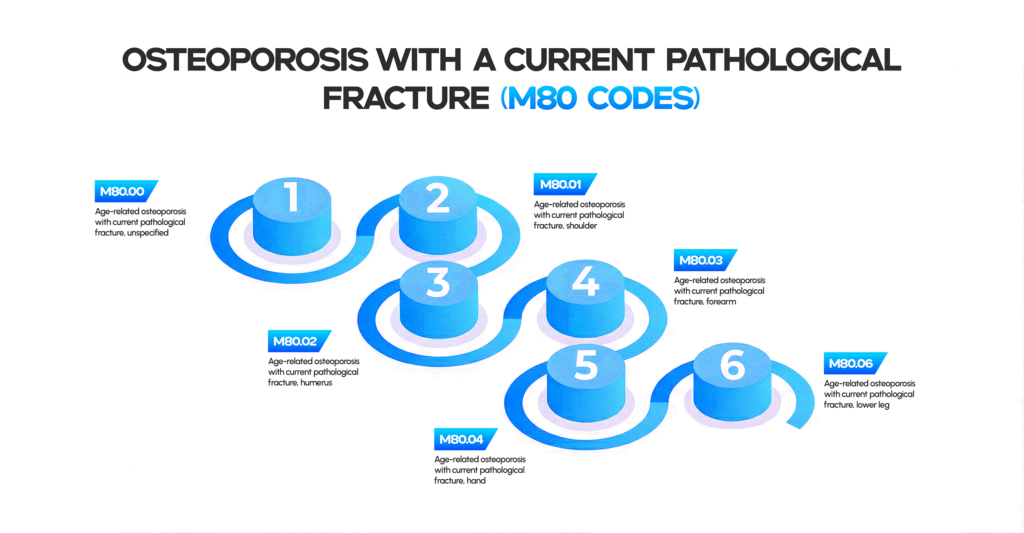
These codes are used when a patient has age-related osteoporosis that has caused a fracture, but the exact site of the fracture is not documented. This code is applied during the initial encounter for treatment of the fracture.
M80.00 – Age-related osteoporosis with current pathological fracture, unspecified
Used when age-related osteoporosis has caused a fracture, but the fracture site is not specified. Applied during the initial encounter for treatment
M80.01 – Age-related osteoporosis with current pathological fracture, shoulder
Applied when osteoporosis leads to a fracture in the shoulder region, typically the proximal humerus near where it joins the shoulder joint. Used for initial evaluation and treatment of the fracture.
M80.02 – Age-related osteoporosis with current pathological fracture, humerus
Used when osteoporosis causes a fracture in the upper arm (humerus), excluding the shoulder region. This code is selected for the initial encounter for treating the fracture
M80.03 – Age-related osteoporosis with current pathological fracture, forearm
Applied when age-related osteoporosis results in a fracture of the forearm bones (radius and ulna). This code is used during the first visit for fracture management.
M80.04 – Age-related osteoporosis with current pathological fracture, hand
Used when osteoporosis causes a fracture in the bones of the hand (including metacarpals and phalanges). Selected for the initial encounter of treatment.
M80.06 – Age-related osteoporosis with current pathological fracture, lower leg
Used when age-related osteoporosis causes a fracture of the tibia or fibula (bones of the lower leg). Applied during the initial encounter for fracture care.
2. Osteoporosis without a Current Pathological Fracture (M81 Codes)

These codes begin with M81 and are used when osteoporosis is present, but no fracture has occurred or is currently being treated.
M81.0 – Age-related osteoporosis without current pathological fracture
Bone thinning that develops naturally with aging, without any active fractures.
M81.4 – Drug-induced osteoporosis without current pathological fracture
Bone loss caused by long-term use of certain medications, such as steroids, occurs without fracture.
M81.5 – Disuse osteoporosis without current pathological fracture
Weakening of bones due to limited movement or prolonged inactivity, without fracture.
M81.8 – Other osteoporosis without current pathological fracture
Covers types like postmenopausal or unexplained osteoporosis that don’t fall into another specific group.
M81.9 – Osteoporosis, unspecified without current pathological fracture
Used when osteoporosis is diagnosed but the cause isn’t clearly documented, and no fracture is present.
Right Way to Code Osteoporosis in ICD-10
Accurate ICD-10 coding for osteoporosis starts with understanding the patient’s clinical status and documenting details clearly.
- Determining the Fracture Is Present
The first and most important step is identifying whether the patient has a current pathological fracture. If a fracture is present, osteoporosis is coded from the M80 series, which reflects a more severe condition. When no fracture exists, the correct category is M81. This distinction directly affects treatment planning and claim management, making it essential to confirm fracture status before selecting a code.
- Identifying the Cause of Osteoporosis
Next, determine what is contributing to bone loss. Osteoporosis may be age-related, drug-induced (such as from long-term steroid use), or caused by disuse due to prolonged immobility. Other forms include postmenopausal or idiopathic osteoporosis. Identifying the underlying cause helps ensure the code accurately reflects the patient’s condition and supports appropriate clinical decisions.
- Documenting Key Details for Fractures
When a fracture is present, documentation must include specific details such as the fracture site, laterality (left or right), and encounter type initial visit, subsequent care, or sequela. These elements are required to assign the correct M80 code and help track healing and recovery.
- Selecting the Most Specific Code
Always select the most specific ICD-10 code supported by the medical record. Unspecified codes should be used only when necessary. Detailed and precise coding improves care coordination, supports correct reimbursement, and creates a clear clinical picture of the patient’s bone health
Pitfalls and Challenges in Osteoporosis Coding
Assigning ICD-10 codes for osteoporosis can be tricky, and several factors often make the process more complicated:
- Incomplete Documentation
Medical records don’t always clearly indicate the fracture site, which side is affected, or the exact cause of osteoporosis. Missing details make it hard to assign the correct code.
- Determining the Presence of a Fracture
Some fractures may be subtle, healing, or documented incompletely. Distinguishing between patients with or without a current pathological fracture requires careful review.
- Choosing the Correct Code Series
Knowing when to use M80 for fractures versus M81 for osteoporosis without fractures can be confusing, especially if the details in the record are unclear.
- Tracking the Type of Encounter
For M80 codes, it’s important to note whether the encounter is initial, subsequent, or for sequela. Missing this step can lead to inaccurate coding and billing errors.
- Overusing Unspecified Codes
Using unspecified codes may seem easier, but it reduces the accuracy of the patient record, complicates clinical communication, and can impact insurance reimbursement.
For practices managing osteoporosis-related fractures, partnering with an experienced orthopedic billing service like Liberty Liens can streamline ICD-10 coding, fracture documentation, and lien management, letting clinicians focus on patient care while ensuring accurate reimbursement.
Conclusion
In conclusion, osteoporosis is a common but often overlooked condition that weakens bones and increases fracture risk, impacting quality of life. Understanding the disease, its risk factors, and progression is vital for patients and healthcare providers. Accurate ICD-10 coding is essential for documenting the condition, guiding treatment, and reflecting true bone health.
Correct coding involves identifying fractures, determining the underlying cause, and choosing the most specific code. Although challenges like incomplete or incomplete documentation exist, careful attention ensures accuracy. Proper coding improves clinical communication, supports patient care, enables accurate billing, aids research, and helps prevent complications.