
Medical billing is the backbone of every healthcare organization’s revenue cycle. It ensures that providers are properly compensated for the care they deliver. However, the different medical billing time limits by state can make timely submissions a real challenge. Failing to meet these deadlines can lead to claim rejections, financial losses, and unnecessary administrative delays.
This comprehensive guide explains how medical billing time limits work, how they vary across states, and what you can do to stay compliant. By the end, you’ll understand the timelines, how to avoid costly mistakes, and how to optimize your specialty billing practices—especially if you operate in regions like California or handle programs such as Medicare and Medicaid.
What Are Medical Billing Time Limits and Why Do They Matter?
Medical billing time limits are the specific deadlines healthcare providers must meet when submitting insurance claims after delivering a service. These timelines are vital to ensuring providers receive timely reimbursement.
Missing these deadlines often leads to claim denials or permanent loss of payment—directly impacting cash flow and revenue stability. Since every payer (federal, state, or private) has its own rules, staying informed is key to a smooth revenue cycle.
Federal programs like Medicare have universal filing limits, while Medicaid and private insurance depend on state regulations or insurer contracts. This means that if your organization provides services across multiple states, you must understand and track each state’s unique requirements.
For example, medical billing professionals handling pain management billing face additional challenges due to complex documentation and authorization needs. Failing to meet time limits in such cases can significantly delay payment.
Filing Deadlines for Common Claim Types

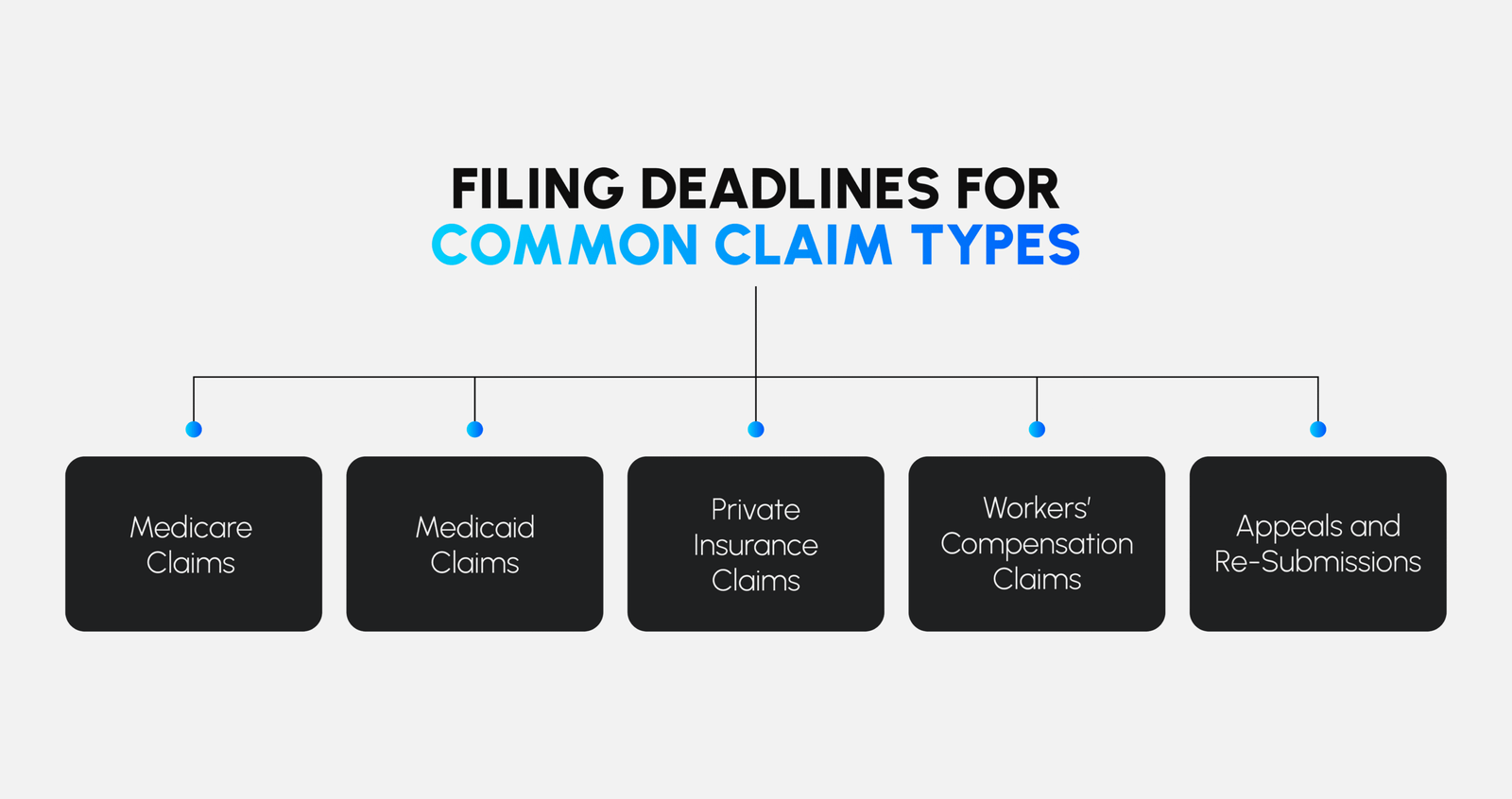
The time limit for filing a claim depends on the type of insurance involved. Below is a breakdown of typical deadlines and what they mean for billing professionals.
1. Medicare Claims
Under Medicare rules, claims must be filed within 12 months (1 year) from the date of service. This consistency makes Medicare billing easier to manage across states. However, missing the one-year mark almost always results in a denied claim.
2. Medicaid Claims
Medicaid, administered at the state level, has varying deadlines depending on the state’s policies:
- California: 12 months from the date of service
- Texas: 95 days
- New York: Up to 2 years (depending on case details)
Because of these differences, billing professionals must verify the Medicaid submission limit for each patient’s state before filing.
3. Private Insurance Claims
Private insurance billing can be even more inconsistent. Each carrier sets its own timeline—usually between 60 and 180 days—as stated in the provider’s contract.
To avoid missed deadlines, practices should implement tracking systems or billing software that automatically monitors each insurer’s unique filing limits and sends reminders for approaching deadlines.
4. Workers’ Compensation Claims
Workers’ compensation claims vary by state and often depend on employer reporting and case complexity. Most states allow 1–2 years for claim submission, but reimbursement can be delayed if the claim involves disputes or legal reviews.
Billing teams must coordinate with the worker’s state laws and maintain accurate injury and treatment documentation to ensure compliance and reduce denials.
5. Appeals and Re-Submissions
Even if a claim is denied, there’s often an opportunity to appeal or resubmit the claim. However, these actions also come with strict deadlines—typically 30 to 90 days after the denial notice.
For example, if your claim is rejected due to a coding error like an incorrect ICD-10 code (e.g., M54.50), correcting and resubmitting within the appeal window is essential to secure payment.
State-by-State Medical Billing Time Limits
Below is a summarized view of typical Medicaid, Medicare, and private insurance claim deadlines across U.S. states.
|
State |
Medicaid |
Medicare |
Private Insurance |
|
Alabama |
365 days |
12 months |
180 days |
|
Alaska |
365 days |
12 months |
180 days |
|
Arizona |
365 days |
12 months |
180 days |
|
Arkansas |
120 days |
12 months |
90 days |
|
California |
12 months |
12 months |
180 days |
|
Colorado |
12 months |
12 months |
180 days |
|
Connecticut |
90 days |
12 months |
180 days |
|
Florida |
365 days |
12 months |
90 days |
|
Georgia |
90 days |
12 months |
180 days |
|
Illinois |
90 days |
12 months |
180 days |
|
Louisiana |
365 days |
12 months |
180 days |
|
New York |
12 months |
12 months |
180 days |
|
Texas |
95 days |
12 months |
180 days |
|
Virginia |
12 months |
12 months |
180 days |
|
Washington |
12 months |
12 months |
180 days |
|
Wisconsin |
12 months |
12 months |
180 days |
|
Wyoming |
365 days |
12 months |
180 days |
Tip: Always confirm the latest filing limits with your state’s Medicaid office or payer representative, as timelines may change.
Common Coding Errors That Cause Claim Denials
Submitting a claim on time is only half the battle—accuracy matters just as much. Coding errors remain one of the top causes of claim denials.
Common issues include:
- Using outdated or incorrect diagnosis codes
- Mismatched procedural (CPT) and diagnostic (ICD-10) codes
- Missing modifiers
- Incomplete patient or coverage details
To minimize these errors:
- Conduct regular coding audits
- Use AI-assisted billing tools for code validation
- Provide ongoing training for your billing staff
This proactive approach improves accuracy, reduces rejections, and helps maintain consistent cash flow.
Pain Management Billing: A Complex Specialty
Pain management billing is one of the most detail-oriented areas of medical billing. It requires precision in documentation, pre-authorization, and coding. Here’s how to optimize it:
- Use the correct CPT and ICD-10 codes for chronic and acute pain treatments.
- Verify pre-authorization for pain procedures before treatment.
- Maintain thorough documentation of treatment plans, progress notes, and outcomes.
- Keep billing staff updated on policy and code changes.
These best practices can improve both reimbursement accuracy and billing efficiency.
Spotlight: Medical Billing Services in California
California’s healthcare billing environment is uniquely complex, influenced by Medi-Cal policies, workers’ compensation laws, and a diverse payer mix. For many providers, outsourcing to professional medical billing services in California can dramatically reduce errors and improve turnaround times.
A trusted billing partner can handle:
- State-specific compliance and documentation requirements
- Appeals and denied claim management
- Integration with EHR and billing software
- Reporting and performance tracking
Outsourcing not only saves time but also allows healthcare providers to focus more on patient care instead of administrative burdens.
Tools and Resources for Billing Professionals
Technology has revolutionized medical billing. Platforms such as Epic Systems, Kareo, and AdvancedMD make it easier to stay compliant by:
- Tracking claim deadlines
- Automating submission reminders
- Reducing manual entry errors
- Simplifying payer communication
Additionally, staying connected with state Medicaid offices, medical billing associations, and industry newsletters helps billing professionals stay informed about regulation updates and best practices.
Your Action Plan for Seamless Medical Billing
Efficient billing is built on timely submissions, error-free coding, and compliance with state-specific rules. Here’s how to put it all together:
- Understand the time limits for all payers you work with.
- Use automated billing software to track deadlines and resubmissions.
- Conduct regular audits to identify potential errors early.
- Stay updated on state and federal billing regulations.
- Outsource specialized billing to experts when dealing with complex cases or high-volume claims.
By mastering these steps, your practice can achieve better revenue consistency, reduced denials, and stronger financial stability.
Final Thoughts
Understanding and adhering to medical billing time limits isn’t just about compliance—it’s about protecting your bottom line. Whether you’re managing Medicaid in Texas, private insurance in Florida, or specialized billing in California, knowledge and organization are your best allies.
To stay informed about state-specific billing regulations and receive professional guidance on streamlining your billing operations, visit our website and explore how our experts can help optimize your revenue cycle.